


A mining truck the size of a two-storey house is driving itself across the Pilbara right now. When its cellular link drops, and across most of that landscape it does, a control room loses sight of a five-million-dollar machine. The fix for this already exists in orbit. The catch is that getting the data down means betting on one satellite network and hoping it has a satellite overhead at the right moment. I believe that bet should not have to exist.
Satellite IoT is deployed infrastructure, not a forecast
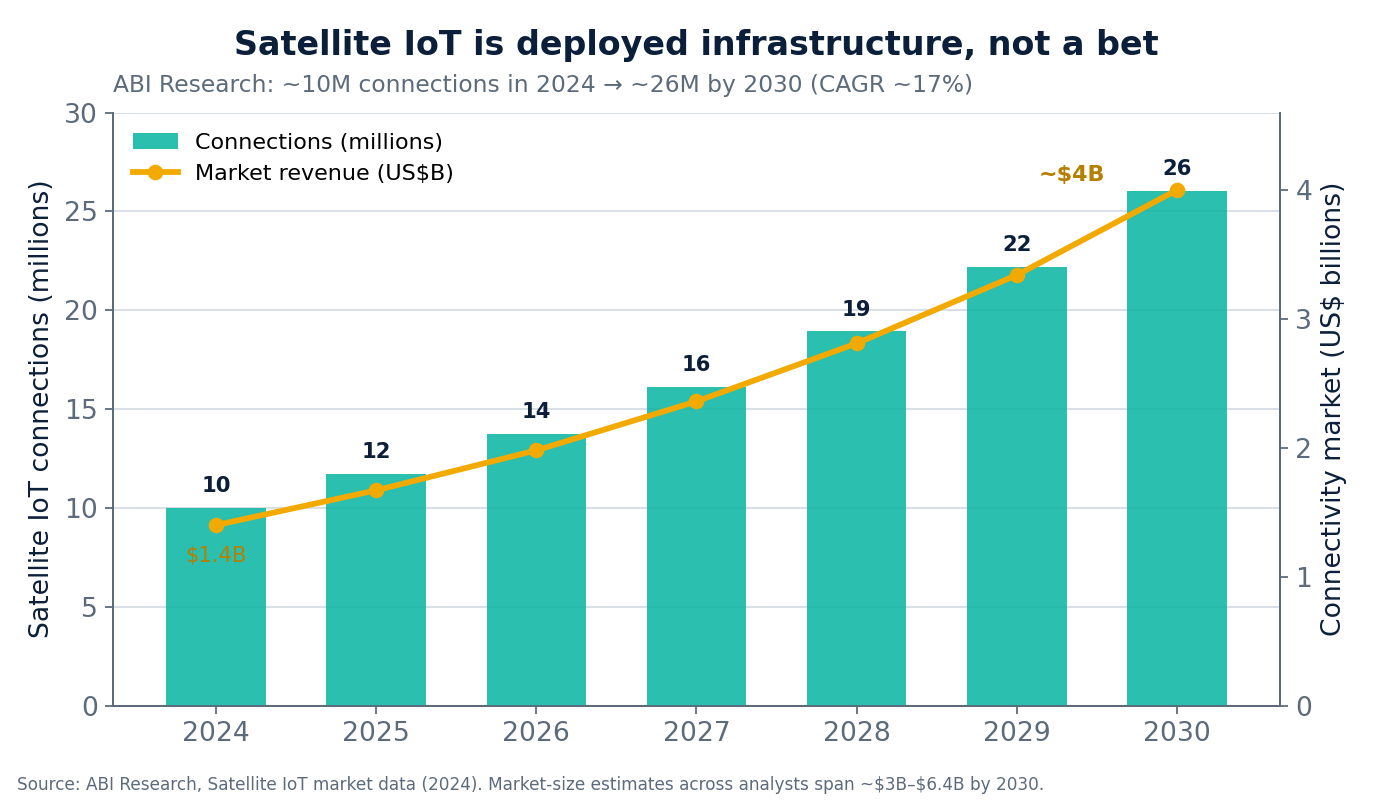
By 2030, roughly 26 million IoT devices will connect over satellite, up from about 10 million in 2024, on ABI Research’s numbers. And by connect over satellite; I do not mean phones. I am referring to machines: autonomous haul trucks, pipeline pressure sensors, ocean cargo containers, soil-moisture probes, livestock tags.
About 85% of the Earth’s surface has no cellular coverage at all, a figure that comes, tellingly, from Iridium, one of the largest players in this space. Across that 85% with no coverage, the only way to move a byte is a satellite.
The connectivity layer is worth somewhere around $4 billion by 2030 on ABI’s estimate, with other analysts estimating it to be between roughly $3 billion and $6.4 billion, depending on how/what they count. The spread today does not really matter. The direction of growth does. This is deployed infrastructure with a clear bottleneck and latent demand that is exceeding supply.
The problem stated plainly
Each constellation is a closed network. Iridium, Myriota, Kineis, Swarm (now part of SpaceX), Skylo, ORBCOMM, Sateliot: every one runs its own protocol, its own API, its own ground stations, its own billing. An industrial operator deploying 500 sensors picks one and is married to it for life. Three consequences follow from this, and they compound:
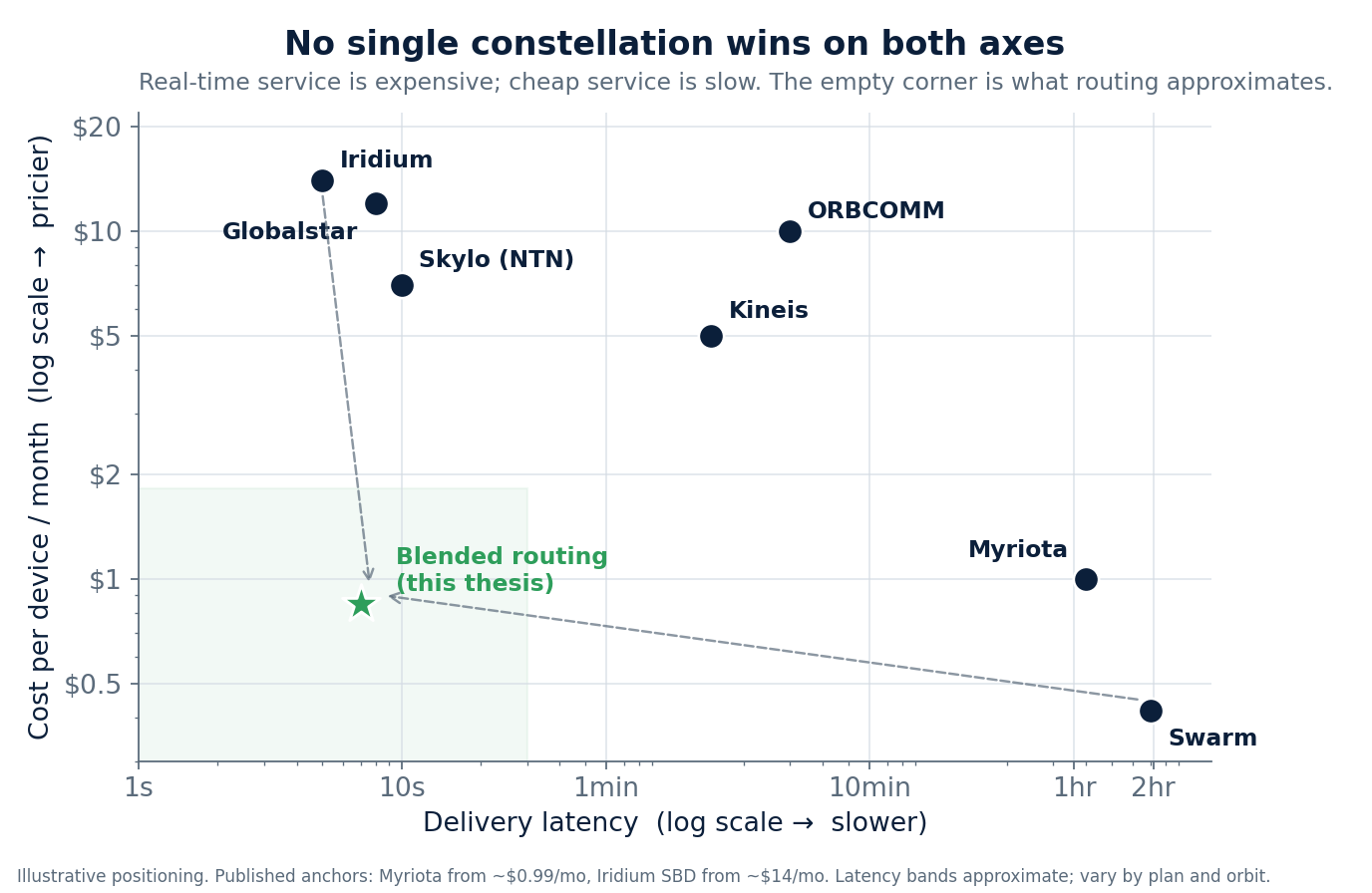
Coverage and timing gaps: No single constellation gives you real-time coverage everywhere. The cheap networks are store-and-forward: a satellite passes overhead, scoops up your data, and drops it when it next sees a ground station, which can be minutes or hours later. Myriota sells that model from about $0.99 per device per month. The real-time networks cost an order of magnitude more; Iridium’s Short Burst Data starts around $14 per device per month and bills usage on top. The right answer for a fleet is almost never one network. It is urgent alerts over a real-time link and routine telemetry over a cheap store-and-forward link, chosen per message. Nobody can do that today through a single integration.
Zero failover: If your provider has a ground-station outage, loses a satellite, or simply has no pass over your coordinates for the next ninety minutes, your devices go dark. There is no automatic reroute to another network, because there is no other network you are connected to.
Integration burden: Supporting a second constellation means a second firmware integration, a second cloud API, a second billing relationship, a second support contract, a second failure mode to learn. So most operators do not currently have redundancy. They accept single-provider risk and call it simplicity. It is simplicity the way a single-engine plane is simple.
The telecom parallel (and where it breaks)
Before Twilio, sending an SMS from software meant integrating one carrier’s API. Switching carriers meant rewriting the integration. Twilio put one API over all of them, added routing, failover and usage pricing, and developers stopped thinking about carriers. Satellite IoT sits at that pre-Twilio moment. Multiple constellations are live today. None of them talk to each other.
Here is the part most versions of this pitch skip: The 3GPP standards body has already made satellite a native part of cellular IoT. Release 17, which was frozen in 2022, added NB-IoT and LTE-M over non-terrestrial networks. Release 19, which was drafted in late 2025, adds store-and-forward operation and a 5G-core path. The radio link is converging. But a standard for how a modem talks to a satellite is not a standard for which network to use, at what price, under whose SLA, billed how, with what reroute when one operator drops.
3GPP standardises the wire that carries the signal. It does not standardise the routing and the commercial layer on top. That is the gap, and the opportunity does not close on the 3GPP timeline.
What the routing layer actually does
Ideal state: One API that accepts telemetry from any device and delivers it over the best available satellite path.
Device side: a lightweight firmware SDK, or a multi-modem gateway, that can reach more than one constellation.
Cloud side: constellation-specific adapters that normalise every inbound message into one format, regardless of which network carried it.
Middle-layer in between: a routing engine that picks the path per message on three variables.
Latency requirement: is this an urgent alert or a once-a-day reading.
Cost: a dollar of store-and-forward against fifteen dollars of real-time.
Availability: which constellation actually has a satellite over this device’s coordinates in the next window.
The interesting asset here is not the router. It is the exhaust. Every message routed produces a data point no single operator can see: delivery success by geography, latency distributions by time of day, comparative reliability across networks at the same location.
After enough volume, the routing engine knows things about real-world constellation performance that the constellations themselves cannot know about each other. The routing gets smarter with use. That is the moat, if there is one to be built.
WHAT THE CUSTOMER SEES: One API. One dashboard. One bill. No lock-in. Automatic failover.
Where we start: autonomous mining in the Pilbara
Pick the wedge where the pain is sharpest and the buyer has money - Autonomous haul trucks in Western Australia.
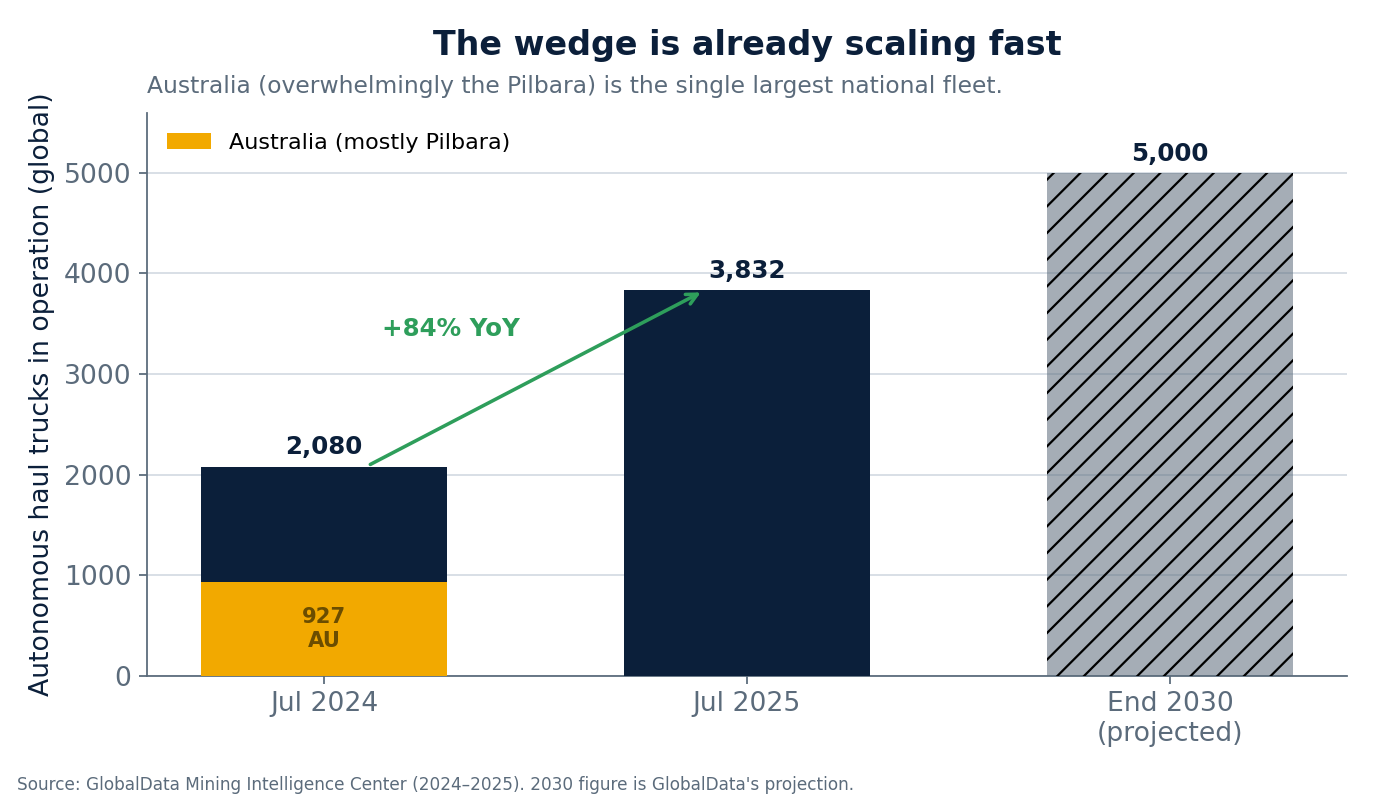
The global autonomous-truck fleet went from about 2,080 in mid-2024 to 3,832 a year later, an 84% jump, and is projected to approach 5,000 by 2030 (GlobalData). Australia holds the single largest national fleet, 927 of those trucks as of mid-2024, overwhelmingly in the Pilbara iron-ore region. Fortescue alone has ordered 360 autonomous trucks from Liebherr through 2030.
These machines, ultra-class haulers costing around $5 million each, run across terrain with patchy or no LTE. When the terrestrial link drops, the control room loses telemetry on the asset. The incumbent fleet systems, Caterpillar MineStar and Komatsu’s dispatch, watch only their own OEM’s equipment and have no satellite fallback.
So the wedge product is concrete: satellite-connected telemetry modules on the trucks, routed through whatever constellation has the best pass at that moment, feeding one OEM-agnostic view of the whole mixed fleet on a single screen.
Mining is the entry point because the trucks are expensive, the coverage is bad, and the buyer already counts downtime in dollars per minute. The middleware underneath is horizontal. It works the same for autonomus highway trucks, pipelines, cargo and crops.
The two ways this thesis could be wrong
1. The wholesale problem
Twilio worked because carriers wanted to wholesale their networks; termination was a commodity they were glad to sell. Constellation operators are currently the opposite. They monetise the whole stack, device to airtime to application, and an aggregator who makes them interchangeable could be seen as a threat, not a customer.
If the operators refuse clean wholesale access, the routing layer is stuck buying retail and reselling, with no margin and no leverage.
The counter: the long tail of operators fighting for relevance against Iridium and Starlink have every reason to accept aggregated demand. The bet is that fragmentation creates willing sellers.
2. The closing window
If 3GPP NTN converges quickly and one network achieves genuine global real-time coverage cheaply (Starlink direct-to-cell and Skylo are both pushing here), then the fragmentation that justifies a routing layer evaporates and the layer gets eaten from below.
The bet is that physics and economics keep coverage fragmented through this decade:
no single constellation is cheapest
lowest-latency and available everywhere at once
because those goals trade off against each other in orbit. The day that stops being true, this thesis is over.
Both objections are the first thing anyone who works in this field will raise. Meeting them up front is the difference between a thesis and a real company.
What I’m looking for
Conversations. If you run IoT devices in places where connectivity is a daily fight, I want to understand the pain in detail. If you build on satellite IoT infrastructure, I want to know what is actually broken versus merely annoying. If you have solved a piece of this, I want to learn what you learned. Reply here, or find me at nitthinchandran@gmail.com
SOURCES & FIGURES
26M connections / ~$4B by 2030 - ABI Research, Satellite IoT market data (2024). Analyst range ~$3B–$6.4B; ABI connection-revenue forecast up to $7.8B.
-85% of Earth without cellular coverage - Iridium, widely cited (~15% of the surface has cellular service).
Myriota ~$0.99/device/mo; Iridium SBD from ~$14/mo - Myriota published plans; Iridium Short Burst Data line-rental pricing (Ground Control). Latency bands approximate, vary by plan and orbit.
3GPP NTN: Rel-17 (2022), Rel-19 (late 2025) - 3GPP release notes; NB-IoT/eMTC over NTN standardised in Rel-17, store-and-forward + 5G core in Rel-19.
Autonomous trucks: 2,080 (Jul 2024) → 3,832 (Jul 2025), ~5,000 by 2030; Australia 927 - GlobalData Mining Intelligence Center. 2030 figure is a GlobalData projection.
Ultra-class haul truck ~$5M - Caterpillar 797-class pricing (industry reporting). 793-class run lower (~$3–4M).