

Lately I’ve been on a solitary kind of search; trying to find where I fit in this vast expanse, and what any of this means in my tiny blip of time on a cosmic scale.
The quiet, uncomfortable question underneath it all is simple: who even notices? A God? Or am I just burning out into the void, unobserved?
Journeys to the unknown do a fascinating thing to your mind- they take you on a path that makes you pause, it shows you things and patterns and presumptions that make you want to be still, till you make some semblance of sense about it. The stillness is visceral at times, and in this stillness at times is born great chaos, from which you observe for the first time; threads and silhouettes of pure beauty in the patterns of how existence weaves.
This is part 1 of a 3 (or) 4 part series (hopefully), at one of these pauses I am currently at.
Some things start stupidly simple. Like a light switch. And when you flip the light switch, you think you’re “sending electricity”. You’re not.
Here's what actually happens: electrons in the copper don't flow from switch to bulb like water through a pipe. The electrons themselves drift at roughly 0.1 millimeters per second; a snail would outrun them. Yet the light turns on instantly, because the signal travels at about 70% the speed of light.
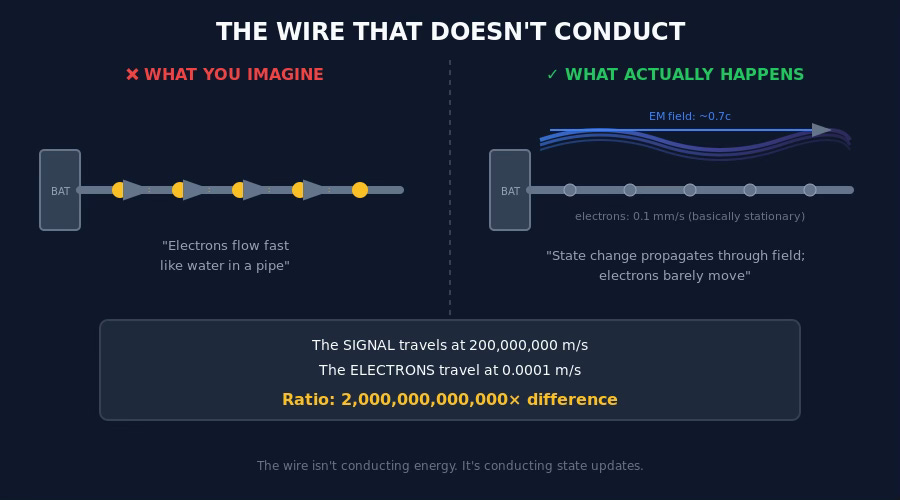
Basically, you’re starting a rumour in a lattice of atoms. And this rumour travels at near-light speed while the actual electrons barely move. The wire isn’t conducting energy. It’s conducting an inference about a state-change that happens somewhere to it, a “belief”.
How? The electromagnetic field propagates. Each atom's electron cloud shifts slightly, changing the local field, which shifts the next atom's electrons, which changes that field. Imagine the first few goosebumps as the summer breeze grazed by you, just that now it’s a cascade of state-changes that ripples through the wire at 200,000 kilometers per second, while the actual electrons barely budge.
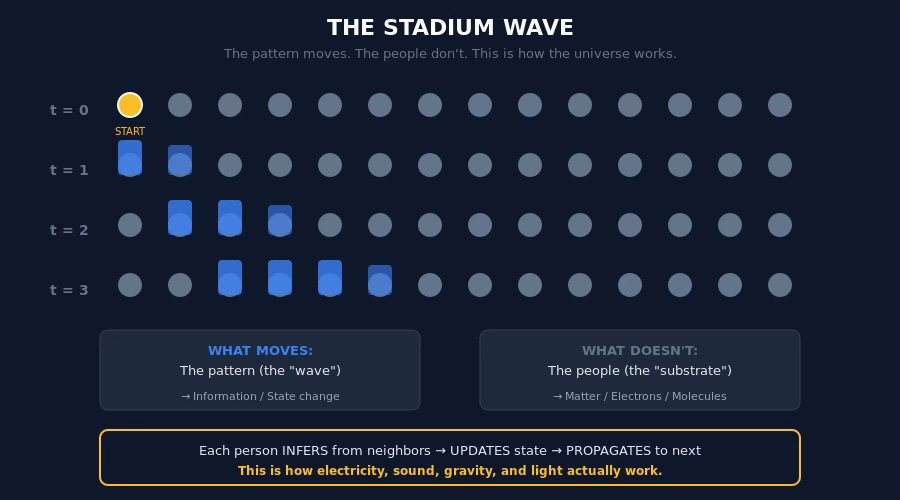
And it’s not just wires that transmit electricity. Take a stadium full of people watching their favourite team. The game catches fire, the crowd gets loud, and someone starts a stadium wave. No person travels around the stadium. Each person just infers from their neighbour, “oh, I should stand now,” and updates their own state. The "wave" is pure information propagation. A moving pattern, made of people who stay where they are.
The wire is doing the same kind of thing. It’s not shoving energy down a pipe. It’s letting each atom “read” the state of its neighbours, adjust itself, and “write” a new state for the next one to read. A long chain of tiny, local alignments.
Here’s what I think is happening: what we call "physics" is better understood as inference :- local state updates propagating through channels according to consistent rules.
The universe, as we experience it; is not a machine that processes energy.
It is a machine that propagates state-changes. What we “experience” as forces, fields, and causation are channels through which these updates flow.
All the separate boxes we live inside - “physics”, “technology”, “social networks”, “society”, “markets”, “mind” - are just different channels through which the same kind of update runs through. We’re not outside that process. We’re the witnesses, the participants, and, sometimes, the ones pushing the next update along.
Signal and noise are therefore no inherent properties of reality, they’re properties of the channel we’re tuned to.
If you want the most compressed version of all this: think of the universe as a giant cellular automaton: a grid where each point just updates its state based on its neighbours, using simple rules.
I’m not saying “physics is inference” in some mystical way. I’m saying the math it seems to follow has the same shape as inference: local updates, rippling out.
And if that’s true, then your life isn’t a random spark in the dark. It’s one very specific pattern in this ongoing wave of updates; the part of the universe that has become aware that the wave is passing through it.
What do I mean by “Inference”?
First, let’s be precise. Inference in a strictly, scientific context is a bit more formal and rigid. It’s not a claim that atoms are “conscious” or that electrons “think”, that lattice “believe” or energy “feels”. That is pseudo-science territory, one I strongly intend to avoid here.
I am looking at the structural definition, the mathematical form of a real-world, physical process that is identical to the mathematically defined (read: equations that most people believe caused their childhood migraines) form of inference.
Students of engineering, statistics and sciences will recognise that in Bayesian inference (if you’re unfamiliar what this is, don’t worry about it for now. This article is supposed to unburden this), you have:
a prior: what you believed before
a likelihood: how new data relates to possible states
a posterior reality: your updated belief
The update rule laid out in mathematical terms can be described as:
Now look at how a physical field evolves. Take the electromagnetic field. At each point in space, the field state depends on:
The previous field state (the prior)
Boundary conditions and sources (the likelihood—how charges constrain what’s possible)
The new field state (the posterior)
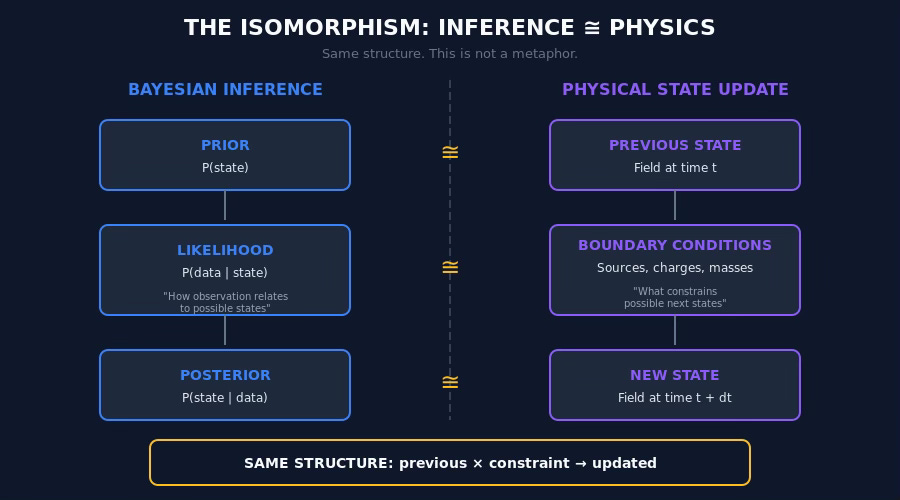
Maxwell’s equations (the ones that made you either fall in love with physics, or decide you never wanted to be an engineer) aren’t philosophically “about” inference. But interestingly, they have the same structure:
a local state
an update rule,
a propagation outcome.
The math is isomorphic. This is just engineering speak for the fact that the mathematics in these two situations has the same structure, so you can treat them as essentially the same problem.
What this implies in practice is that you can safely transfer theorems, formulas, mental models and intuitions from one setting to the other, because nothing essential about the structure changes; only the “labels” do.
The equations don’t feel like they are “belief” updates, but structurally they are, in everyday terms, the following:
yesterday’s rumour
today’s evidence
tomorrow’s new rumour, repeated at every point in space.
This matters because it means we can use inference as a conceptual frame without making claims that violate the physics of the universe. We’re not adding anything to the physics. We’re redescribing what the physics already says.
The wire that doesn’t conduct
Let’s go deeper on the wire example, because it’s the perfect entry point for anyone in the world today who has access to electricity.
The standard picture (which is correct, but misleading)
The middle school textbooks said: voltage difference creates an electric field inside the wire, which exerts force on free electrons, which flow and carry current.
All true. If the teachers cut your marks coz you got this statement wrong, they can’t be blamed. But, there’s a but.
And the but of it is that it frames the wire as a pipe and electrons as water. This creates the illusion that stuff is moving from one end to the other. And that, is fundamentally not true.
The Inference Picture (also correct, yet more revealing)
What’s actually happening at each point inside the copper:
An electron shifts position (due to the applied field)
This creates a local perturbation in the electromagnetic field, like the ripple you cause when you dip your feet into the pool
The perturbation propagates outward at near-light speed
Neighboring atoms’ electrons “respond” to the changed field
They shift, creating new perturbations
This cascade continues on and on
The key insight here: the signal is in the field, not the electrons. The electrons are just the substrate that couples to the field. The “information” - the state-change; propagates through the field channel, which is the latticework of atoms in the wire.
In this frame, the wire stops being a pipe and starts being a rumour network: some rumours hug the surface, some echo back and forth, some pass without any friction at all.
This also explains why kitty-party groups are considered disruptive, although they aren’t the ones doing the disruption.
Why this framing matters
This isn’t just semantics. It highlights and predicts a real phenomena, and some hard words that you’ll need to brace for:
Skin effect: At high frequencies, current flows mostly near the wire’s surface. They prefer to move along the “skin” of the wire.
Why? Because the field’s propagation dynamics change at high frequencies. Meaning - the rate at which the ripple feel at the edge of the pool where you dipped at the foot, will be felt different a few feet below the pool, or at the middle and opposite end of the pool.
The “inference channel” has different properties near the surface than deep inside.
Transmission line behaviour: Long cables don’t act like simple pipes. They act like they disagree with a ripple being there, and fight back, talk to each other and do things of their own. In physics, this means they behave as wave propagation channels with impedance, reflection, and interference. And therefore things heat up, for real. Heat is a consequence output in these physical phenomenons.
Why do they do this? Because that’s what they inherently are: inference channels, with bandwidth limits (how much water can flow) and echo patterns (some ripples get reflected back).
Superconductivity: Below critical temperatures, resistance drops to zero. In inference terms: the channel becomes lossless. The lattice stops “disagreeing” with the field state, it synchronises perfectly, so no information is lost to heat.
The inference frame about the universe and its working doesn’t contradict the physics. It pulls forward the parts that the “water in a pipe” metaphor I used earlier hides.
Forces as inference channels
If the electromagnetic field is an inference channel, what about the gravity that hold us on earth and keep the moon in its orbit? The other strong forces? What about sound?
Let’s check each one.
Gravity: geometry as inference
In Einstein’s general relativity, mass doesn’t “exert force” in the Newtonian sense (meaning, the way Newton perceived the laws of the world and how all the mass in the universe behaves).
Mass curves spacetime. Other masses follow geodesics: the straightest possible paths through curved space.
If we had to reframe this: mass updates the local geometry. That updated geometry propagates outward at the speed of light (as gravitational waves). Other masses read that geometry and update their trajectories accordingly.
This isn’t speculation. Einstein’s field equations describe exactly this: how the source of the change/curvature(matter/energy) updates the geometry (metric tensor) at each point in spacetime.
The “inference” that happens here by everything that has “mass” in the universe is: given the local curvature, what geodesic should I follow?
Every mass particle “computes” this continuously. The universe doesn’t need a central processor to this math.
Each point updates locally; the global solution emerges.
In that sense, gravity is the universe’s way of telling any matter, “here’s the shape of the story you’re allowed to follow,” and every particle keeps re-reading that local script as it moves. Destiny for inorganic things with mass, is real.
This goes beyond just astronomy and astrophysics. There’s even a theoretical program, entropic gravity; that attempts to derive Einstein’s equations from information-theoretic principles.
Now what is information-theoretic principles: These are general rules and constraints that come from information theory, describing how information can be quantified, transmitted, stored, and processed, especially under uncertainty and noise.
Examples:
Predicting a fair coin toss (50% heads, 50% tails) gives you 1 bit of information when you see the outcome.
Predicting weather where it is sunny 99% of the time gives very little information to you when it is sunny, because you were almost sure anyway; news about the probability of a rare storm carries more information to you.
These principles give formal limits (what is or is not possible) and optimal strategies (how to do it best) for any system that handles information, from communication channels to learning algorithms and cryptographic schemes. Erik Verlinde’s work suggests gravity might literally be an emergent consequence of entropy gradients. The inference frame isn’t just metaphor; it might be close to a fundamental aspect of our universe.
Electromagnetism: the original signal channel
Maxwell’s equations that you learned in middle-school are explicitly describing a propagation system. They describe how changes in electric fields create magnetic fields, which create electric fields, and so on, forwards at speed cc.
Every antenna engineer knows this. Radio isn’t “sending waves” in some vague sense. What it is doing is:
Create a pattern of charge oscillation
That pattern propagates through the field channel (atmosphere)
A distant antenna’s charges respond to the arriving field pattern
The entire telecommunications industry and our everyday communication, entertainment etc., via every increasingly complex smartphones are built on top of the inference-channel structure of electromagnetism.
Sound: molecular state propagation
Sound is perhaps the clearest and cleanest example we humans can understand.
When you speak:
Your vocal cords vibrate, pushing air molecules
Those molecules collide with neighbors, transferring momentum
Those neighbors push their neighbors
A pressure pattern propagates outward
No molecule travels from your mouth to my ear. The air just passes along tiny shoves, one neighbor to the next, like a tightly packed crowd passing a single, urgent message.
This is precisely inference: each molecule updates its state based on neighbor states, according to the rules of intermolecular forces. The “posterior” (new position and velocity) depends on the “prior” (previous state) and the “likelihood” (forces from neighbors).
Sound velocity depends on the channel’s properties: molecular mass, temperature, medium density.
Higher temperature = faster inference (molecules respond faster).
Denser medium = different impedance (different channel characteristics).
A unifying table
You can observe the same trick across almost everything in the universe, in different costumes. The metaphorical pause in the journey I mentioned at the start, is when you realise that eventually it is all just one universe, endlessly propagating state updates through whatever substrate is available within it.
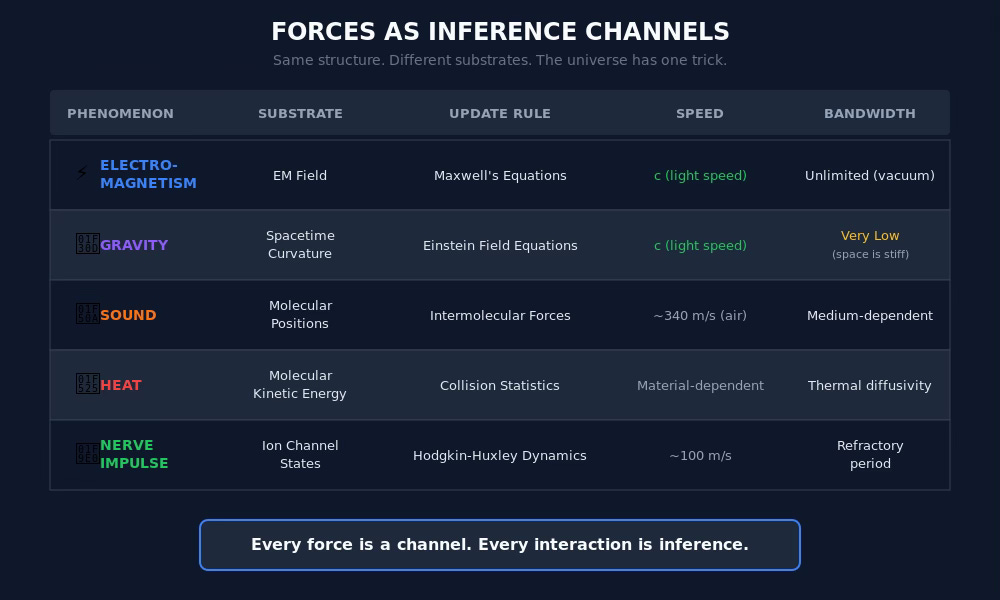
Every physical process can be decomposed into:
substrate (what carries the state)
update rule (how state changes given neighbors)
and channel properties (speed, bandwidth, noise).
The cosmos as distributed inference
Now let’s scale this up, let’s go cosmic in a manner Nolan would be proud of. If local physics is inference, what does the universe look like as a whole?
We see the into the past, to back in time, when we look up at the night sky.
Why? Because inference, on cosmic distances; has observable latency.
The light arriving at your eye from the Sun left 8 minutes ago. The light from Alpha Centauri, the nearest star system to the Sun and also one of the brightest objects in the night sky (and has played an important role in both astronomy and human culture) left 4.3 years ago. The most distant galaxies we observe emitted their light ~13 billion years ago.
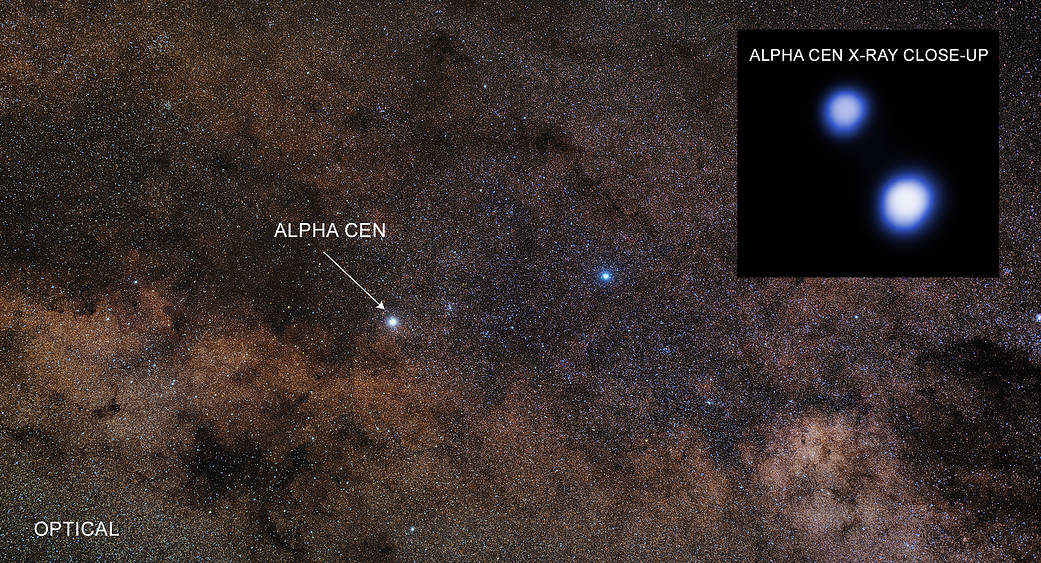
In the inference frame of things: we’re reading old, stale data.
The cosmic microwave background is the oldest cache of this. It is from the universe’s state 380,000 years after the Big Bang, frozen in light and still propagating across the void.
The fascinating bit is that this isn’t just “information traveling slowly.” It’s the fundamental structure of reality. Relativity forbids instant state-synchronization.
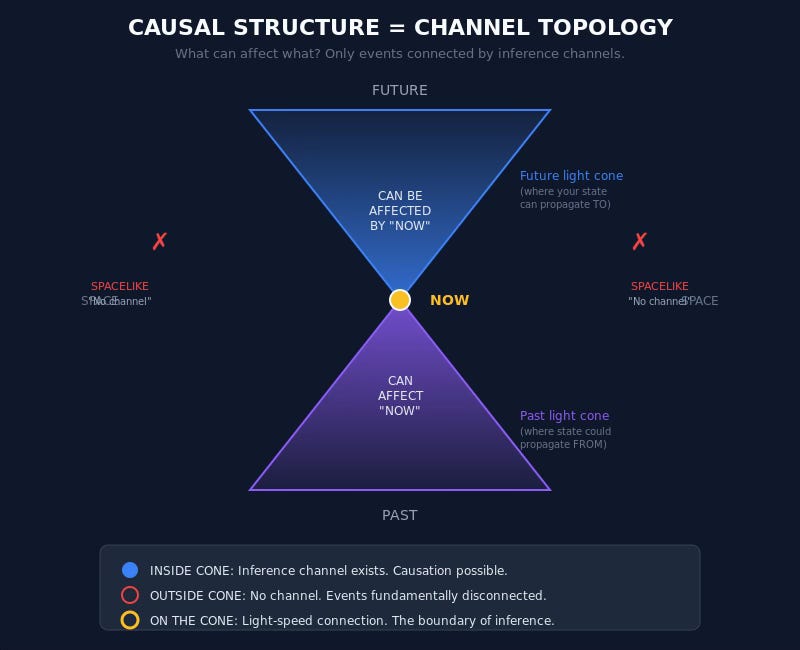
The universe is eventually consistent, just not strongly consistent. Each point in the universe only knows what’s in its past “light cone”.
Causal structure as channel topology
In relativity, events can be:
Timelike separated: one could cause the other (within a light cone)
Spacelike separated: neither can affect the other (outside each other’s light cones)
Lightlike separated: on the boundary (connected by light)
This is channel topology on cosmic scale. Spacelike events are on disconnected channels, no inference can propagate between them. Timelike events share a channel, state updates can flow.
The entire causal structure of the universe is a statement about which inference channels exist.
There are places you can never hear from, and places that can never hear from you. Silence, in this picture, isn’t absence, it’s the geometry of who can’t share an update with whom.
This means the folks at Marvel Comics/Studios could put out a million Multiverse movies filled with aliens villains, and other multiverses could never be offended, because they will never know of the movie’s existence. Think: small privileges on cosmic scale, big wins in keeping alien attacks at bay.
Black holes as channel boundaries
What happens at a black hole’s event horizon? Nolan’s Interstellar managed to get a boring, nerd-level geometric diagram propogated into the imagination of billions, but the math still remains complex.
From outside: nothing can escape. Light, matter, information; all fall in, none return, ever.
The event horizon is a one-way inference channel. “States” can propagate in, but not out.
This creates the (almost)famous black hole information paradox. Quantum mechanics says information is conserved. But if information falls into a black hole and can’t escape, where does it go?
The current best answer (predicted/derived from Hawking radiation + holographic principle): the information is encoded on the horizon surface.
The 2D boundary of the black hole, contains all the information about the 3D interior. The channel here doesn’t destroy information; it transforms how it’s stored.
This is very strange, but it’s mainstream physics. And it’s deeply information-theoretic.
The universe seems to care about conserving information more than conserving matter. Why? Maybe that’s another journey to be made.
Entropy and the arrow of time
One of my biggest torments in 4th grade was things always went ahead. I couldn’t pause to alter, or reverse to edit or change. The broken window remained broken, and the beating was always guaranteed. I could never know in advance how much of a beating I would get, and be prepared for it. Why did time flow only in one direction? Why do we remember the past, not the future?
The thermodynamic answer: Entropy increases. Systems evolve toward more probable states.
The inference answer: the universe is updating toward its maximum-entropy posterior.
The past had lower entropy (more constrained, more informative prior). The glass in the window fit snug and square into the frame. But on breaking it, I’d set the glass shards free. Freedom at last, but now they never could get back to being the single glass slab within the window frame again. The future has higher entropy (less constrained, less informative posterior).
The arrow of time points in the direction of inference: from specific to general, from constrained to unconstrained.
This connects to Jaynes’s profound insight: thermodynamics is inference.
Temperature, pressure, entropy: these aren’t fundamental properties of matter. They’re what you can infer about microstates, given the macrostate observations.
Statistical mechanics is just Bayesian inference applied to particle physics.
The noise that isn’t
Now to a part of a thesis that I find myself wanting to contradict, because it deeply tests my sense of individual actions, impact and the mark our life makes in the fabric of time : the universe doesn’t distinguish signal from noise.
Let me be more careful here. This isn’t about things that sound moral or mystical. It’s about our understanding of the nature of existence (ontology) vs our understanding of nature, knowledge and the limits of knowing (epistemology).
The traditional view on signal vs noise
In electrical engineering or communications theory, signal is what you want to transmit. Noise is what corrupts it. It’s a very binary, simple view of things. And this has worked well for us, the Information Age exists on this key distinction.
And this distinction is purpose-relative: defined by what you’re trying to do.
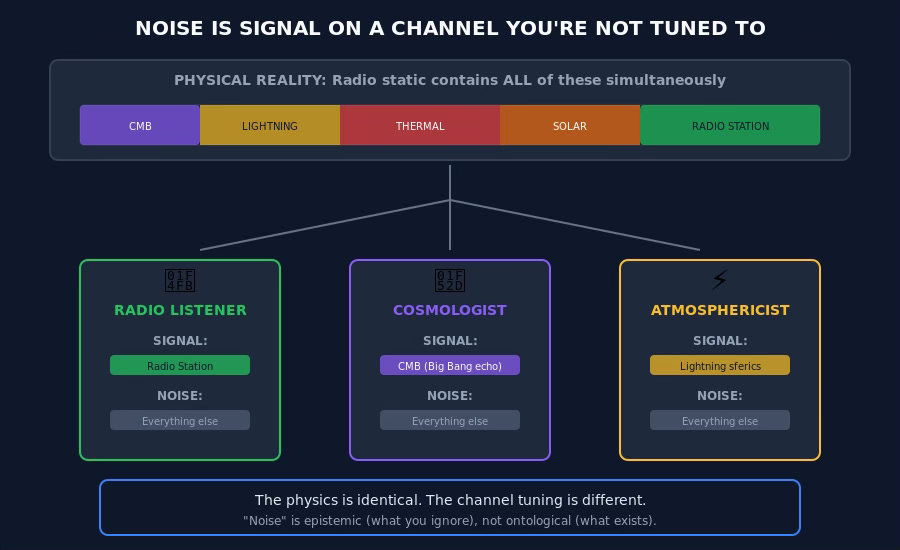
A radio engineer calls this static “noise.” It’s the buzzing you hear when your Zoom call audio breaks into crackles/static(aka “thermal noise”) due to a bluetooth speaker in the vicinity of your laptop. But that static contains:
Cosmic microwave background (residual from the Big Bang)
Thermal radiation from the antenna
Distant lightning strikes
Solar radio bursts
From another purpose, each of these is signal. The “noise” is just signal on channels you’re not tuned to, or you don’t intend to tune to.
When we call something noise, we’re really just admitting, “I’m not listening to that part of the universe right now.”
What’s true on a physical level:
Here’s the key thing: physics has no concept of noise.
Every interaction is deterministic (or, in quantum mechanics, lawfully probabilistic). Every fluctuation has a cause. Every perturbation propagates.
What we call “thermal noise” is actually the EM field faithfully transmitting the state of randomly-moving charged particles. It’s not a failure of the channel. The channel is working perfectly as it should, it’s just carrying information we don’t want.
In empty space out there in the universe, random jitters of energy and fields that occur even in “empty” space due to the rules of quantum mechanics. These so called quantum vacuum fluctuations aren’t “randomness” in the everyday colloquial sense. They’re the ground state of quantum fields: the “base prior”, if you will.
Even it absolute stillness, in what’s supposed to be nothing, just an empty void, the universe still murmurs something in it’s sleep. The universe’s lowest-energy configuration still has a structure to it.
The Holographic Principle and Information Conservation
Jacob Bekenstein was born in Mexico City in 1947, the son of Polish immigrants. William Blake was born two centuries earlier, in 1757, in Soho, London. Separated by time and space, they never met, and they worked in utterly different worlds.
Both went on to write new chapters in their areas of expertise. Bekenstein’s ideas reshaped how physicists think about the information content of the universe, from black holes to cosmological horizons. Blake’s poems and images have radiated outward for over two hundred years, influencing composers, painters, novelists, and the entire “Romantic imagination”.
It is fitting, then, that when Bekenstein set out to question one of the most fundamental assumptions about the universe, he reached for Blake.
Bekenstein asks "Could we, as William Blake memorably penned, 'see a world in a grain of sand', or is that idea no more than 'poetic license'?"
And the answer Jacob discovered, 200 years after Blake asked the question; is : Yes, we can.
If you burn a book, the information in it isn’t destroyed. It’s transformed into millions and millions of fragmented parts in the smoke, ash, and radiation. In principle (assuming you had access to limitless computational resources), you could compute and reconstruct the book from perfect measurements of the combustion products. If you could manage the compute, you could reverse time; and bring the book back to as it was before it burn.
This is the holographic principle. It (well-supported in theoretical physics) states:
the maximum information content of any region of space is proportional to its surface area, not its volume.
Implication: information is never truly destroyed. It can be scrambled, dispersed, transformed; but not erased.
This is real physics, not some meta-physical speculation. Any act of erasure is basically you removing a set of information from object A, and converting it into some energy output, such as hit.
This is true even for digital data. Every time you “erase” information by deleting a photo in your gallery, or even hit backspace to “delete” an entry; you produce a tiny amount of heat.
This is proven by Landauer’s Principle (experimentally verified), which says that erasing one bit of information requires dissipating at least kTln2 of energy.
The formula is just Landauer’s way of saying “erasing one bit of information has a minimum energy cost, and that cost depends on temperature.”
Information and thermodynamics are inherently coupled. The universe keeps records of the state change.
So where does “noise” come from?
The country maps we had in schools for geography class shows us coastline with extremely jagged, random borders. It’s never a smooth curve. It’s “noisy”. But yet, when you stand on the beach, stretching for miles as you walk on the sands, nothing look jagged. The land curves and meanders, and while we are there at that beach in the warm summer sea, there’s only the breeze and the continuous coastline, interrupted by smooth curves. There is no noise.
Noise is a coarse-graining artifact.
Coarse graining = replacing a detailed, fine‑scale description with a simpler one that keeps only “important” variables. In physics, this removal of the un-important variables would be termed as removing “degrees of freedom” from the process.
So what “noise is a coarse-graining artefact” means is if one had a perfectly fine‑grained description (tracking all microscopic degrees of freedom), the process would look smooth and noise‑free; what is called “noise” only appears after simplifying. Imagining zooming in on a torn paper edge under the microscope, as you keep zooming; the details don’t looked jagged as it seems to your naked eye; but smooth continuous curves.
When we model systems, we choose to ignore certain degrees of freedom. Those ignored degrees of freedom manifest as apparent randomness in the degrees of freedom we track.
For example: Let’s take Brownian motion, that describes the movement of independent particles in a given system. A pollen grain in water jitters randomly. But the “randomness” is just the aggregate effect of billions of water molecules colliding with the grain. If you could track every molecule, there would be no randomness, just a very high-dimensional deterministic (or lawfully probabilistic) system.
“Noise” = information on channels you’ve chosen to ignore deliberately .
This has practical implications. Every breakthrough we have had in sensing technology comes from figuring out how to read channels that were previously “noise”: gravitational wave detection, single-molecule imaging, cosmic microwave background mapping.
What this gets us
Let’s head back to the core claim (and what’s not claimed):
Not claiming:
atoms are conscious
the universe has intentions
Physics is reducible to information (it’s still an open question in science)
that the framework/thinking I am discovering makes new empirical predictions that differ from standard physics
What I am claiming:
The mathematical structure of the physical laws is identical (isomorphic) to those of inference
This isn’t an abstract metaphor. I believe it cleanly and clearly is a description of what the equations already say
The framing described above unifies phenomena that I and folks around me have usually treated separately (the forces, fields, thermodynamics, computation, information etc)
Signal & noise are subjective to the observer (strictly speaking, they are not ontological)
Information, as we define it, is physically intertwined with dynamics (as established by Landauer, Holographic Principle, Jaynes’s Information Theory, etc.,)
Why bother with this framing:
For me personally, there’s three reasons:
Clarity:
The world feels less mysterious to me when I can as a simple question: what is the inference channel here?
What’s the substrate? What’s the update rule? How fast do these updates travel, where do they get lost? The same questions apply for a copper wire, a nerve in your body, a rumour, a market, a political ideology, a company’s share performance, an impression about people we interact with daily.
Life more often than not feels like one large Bayesian system, and resisting updates is just to be bling about how the universe wants to talk to us, we’re just sinking deeper into a self-sabotaging ego state.
This reframing gives me handles - place to grab the problem, without pretending that I have “explained” everything happening to me to myself. I can understand things better, but I’m not claiming this is the ultimate, complete explanation of reality.
Coherence:
Ever since we start of in school, we are taught to compartmentalise. To be narrow. Study and keep the world into separate folders: Physics here, Technology there, then “society”, “markets”, “investments”, “mind”; as if all of them are different planets. I have always hated this, always felt this was limiting. And at times made to feel stupid for thinking so.
This framing helps me reset. The universe seems to have a coherence to it. This framing let’s me see the universe as the same story told through different materials; the same kind of wane moving through electrons in a wire, the air in the stadium, spacetime around a star, neutrons in the cortex of our brains, people in a crowd. It’s all one conceptual spine, with many costumes.
For me, this sense of continuity matters. It enables me live one life, instead of five disconnected ones.
Intelligence:
This framing helps me prepare for intelligence. This is very different from “being” intelligent. A lot of very smart folks that I know, exist in the past. They were intelligent once, but something changed.
A lot of people struggle with updating their intelligence, and a lot of scorn is thrown at people who “update” their beliefs as new events occur; it’s almost frowned upon.
Holding onto old “beliefs”, and not updating it in the face of new data is not heroic, it’s contrary to nature.
If we look at the the physics of the universe, physical processes are already doing inference. Our brains aren’t magical exceptions; they are what happens when the universe builds an inference engine that can model itself.
Minds are what inference feels like from the inside.
Why is this important? For me, this shifts the original question, “who notices?”, by just a little bit.
It stops being : is there an external observer keeping the score of what I do?
and becomes: “what does it mean that a small part of this vast update process has become aware that a wave is passing through it, and it can therefore choose how to respond?”
This is the real reason why I care about this framing. It doesn't just tidy up some Physics for me. It changes how I relate to being a brief, fragile pattern in the middle of it all.
Coda: the universe computes itself
There’s a line of thought in Physics that says computation is fundamental. Theoretical physicist John Wheeler famously termed it “it from bit.”
In his 2006 book, Programming the Universe, Seth Lloyd contends that the universe itself is a large quantum computer. He counts up how many operations the universe has run since the Big Bang.
Stephen Wolfram (Physicist + Computer scientist + CEO/inventor of Mathematica and Wolfram Alpha, author of A New Kind of Science), in his work on cellular automata, draws little grids where simple rules only look at their neighbour, update their state to change the pattern over and over again; to spin out to create crazy, rich, complex structures and behaviours that become whole worlds of their own.
All of that is interesting background. But I didn’t start this with Wheeler or Wolfram. I started it with a smaller, more pathetic question: in my tiny blip of time, who even notices?
The inference frame above sits right between those two scales.
On one side, the picture looks like this:
The universe is not a stage on which events happen. The universe is the happening. Each point in spacetime updates its state based on its neighbors, according to the rules we call physical law. There’s no central processor, no global clock, no preferred frame. Just local rules, applied everywhere, always.
Gravity, light, sound, heat - these aren’t different phenomena. They’re the same phenomenon (state propagation) through different channels (spacetime metric, EM field, molecular positions, kinetic energy).
On the other side is me, sitting inside that process, trying to make sense of my one short run at this life.
In this view, there’s nowhere for me to stand outside the computation, no balcony seat from which I get to watch the show.
We’re not observers looking in; we’re ripples inside the “happening”, briefly aware that we are.
The question “who notices?” quietly flips: there is no separate watcher. The noticing is happening here, in you, as part of the same update.
Our memories, our convictions, our sudden late-night clarity; those are just another kind of state-change propagating through this universe-sized inference machine. I am not an error term. I am one of this machine’s patterns of self-measurement.
And that’s where the noise question lands too.
From the inside, so much of life feels like interference: distractions, static, randomness. From the outside; if there were an outside, it would all just be propagation. Every fluctuation, every lost day, every sharp moment of awareness: the same process, different channels.
There’s no noise. There’s only signal we’re not listening to.
Appendix: Key References
For readers who want to go deeper:
“It from Bit” - John Archibald Wheeler’s proposal that information is fundamental to physics. See his essay Information, Physics, Quantum: The Search for Links (1990).
Landauer’s Principle - Rolf Landauer’s proof that erasing information requires energy dissipation. Experimentally verified in 2012 by Bérut et al. in Nature.
Jaynes and Maximum Entropy - E.T. Jaynes’s work treating statistical mechanics as inference. See Information Theory and Statistical Mechanics (1957).
Entropic Gravity - Erik Verlinde’s proposal deriving Einstein’s equations from thermodynamics. On the Origin of Gravity and the Laws of Newton (2010).
Constructor Theory - David Deutsch and Chiara Marletto’s framework recasting physics in terms of possible and impossible transformations.
Holographic Principle - ’t Hooft and Susskind’s proposal that 3D information is encoded on 2D surfaces. Foundational to modern quantum gravity.
Seth Lloyd’s Computational Universe - Programming the Universe (2006), which estimates the universe’s total number of operations since the Big Bang.